
Assessing and Exploring Factors Influencing Sexual and Reproductive Health Service Delivery and Experiences of Adolescent and Young Women in Conflict-Affected Areas of Ethiopia
Introduction: Sexual and Reproductive Health (SRH) service for young women in conflict-impacted areas remains a challenge. Evidence from Ethiopia documents uneven youth SRH service utilization, yet little is known about how post‑conflict health facility readiness and the lived experiences of receiving SRH care jointly shape that utilization.
Methods: We conducted a convergent mixed‑methods study across 5 health centers in Mekelle City, Tigray, between August 15 and December 11, 2025. The quantitative component comprised an SRH service delivery readiness assessment of health centers and a survey of 216 young women. The qualitative component involved semi‑structured in-depth interviews with 16 young women and 3 health leaders, 3 focus group discussions with SRH providers and women’s group representatives, and 2 ethnographic observations.
Photos and reflections on the thesis project
Students submitted photos and reflections as part of their thesis research. All the people in the photos gave permission for their photos to be taken and shared.
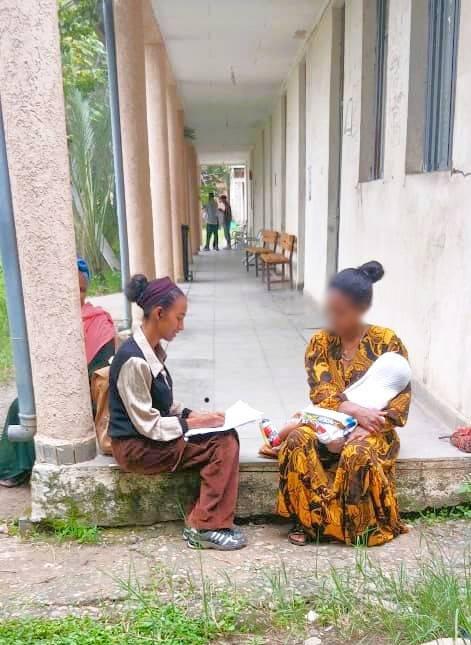
AdiH Health Center, Mekelle City
This photo was taken during one of the in-depth interview sessions by our data collectors. The picture was taken with the consent of the participants.
The participant is carrying her child and is accompanied by her mother, who is not fully captured in the picture, sitting nearby and listening during the interview. The data collector holds the interview guide and converses with the participant. The picture was taken with the full consent of the participant, the data collector, and the participant's accompanying mother, who was sitting nearby.
(The picture is taken with the full consent of the participant, the data collector, and the accompanying mother of the participant sitting nearby. Though all gave consent, we have blurred the face of the participant.)
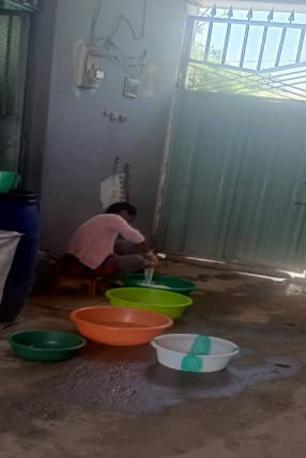
This picture was taken during an ethnographic observation at one of the two participants’ homes.
It shows what role a typical young women play in her family, be it childbearing and raising, serving as a housewife, and doing very tedious but often overlooked roles. In the picture, it appears that the young woman is washing clothes by hand. This is just a glimpse of the roles she carries at home, which consume much of her time and detract from important issues such as education, personal growth, and, indeed, her health.
The picture is credited to Genet, one of the research assistants.
This is the first time the research assistants have participating in ethnographic observation. Initially, during the training, they struggled to understand how the observation could be linked to the health issues (sexual and reproductive) of young women. However, during and after the work was completed, they realized how crucial the observation was in understanding the link between health and daily life tasks for young women.

This photo shows the topography of Mekelle City, the regional capital of the Tigray Region, and the sites of our research project as taken by the field data collection coordinator, Dr. Yemane Tadesse. In the picture, we can see buildings, vegetation, and a local football stadium. This is to give the audience a sense of what Mekelle City looks like.
Despite the city's quiet and beautiful looks, daily life, as the young women tell it, is difficult. There are many security, health access, and joblessness issues affecting how young women access sexual and reproductive health care. There are also thousands of internally displaced people (IDPs) in the city who are still waiting for safe return to their respective villages and homes.
I am very grateful to the team of research assistants who helped with the project. Despite the challenges and the daily realities on the ground in Tigray, which is still suffering from post-conflict instability and changing circumstances, they dedicated their time and effort to complete the job no matter what. Hence, I would like to thank them from the bottom of my heart.