Photos and reflections on the thesis project
Students submitted photos and reflections as part of their thesis research. All the people in the photos gave permission for their photos to be taken and shared.
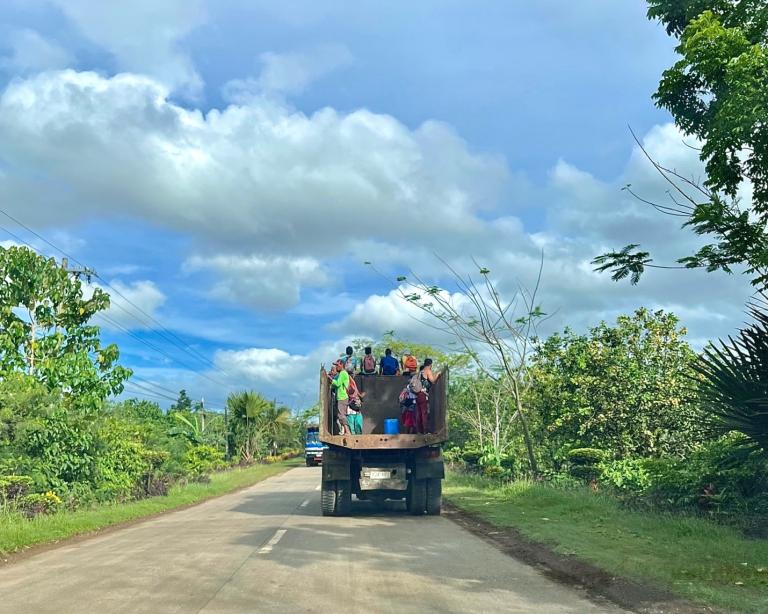
People riding on the back of the truck
This is a common view on the roads of Mabinay, people on the back of a sugarcane truck, holding tightly to the sides as it winds through the mountain roads. The riders still pay to ride. It is cheaper than the bus though far more dangerous. The ride is long and exhausting, and precarious. One sharp turn could throw them off, no matter how tightly they cling. Passengers stand for hours, balancing under the scorching sun, some perched on top in front, and sometimes even children ride along.
Mabinay, a plateau in the mountains of Negros Oriental, is a major producer of sugarcane. Trucks like these are meant to haul sugarcane to the city’s big milling factories, but they have also become transport for people. Mabinay is a first-income class municipality, which means it can fund and provide more services to its people. However, sugarcane farmers in Mabinay, known as tapaseros (sugarcane cutters), remain extremely poor. They do not own the land they have tilled for generations; they remain laborers on it. The wealth of sugar production is concentrated in the hands of the hacienderos (landowners) while farmers and their families barely subsist.
Watching people cling to the backs of these trucks, I can’t help but think about the risks they endure because safer transport is out of reach. In my research on intimate partner violence in Mabinay, it makes me wonder: what are the risks women endure in their own homes when leaving feels even less possible? How do they understand and name their experiences, and what does liberation mean to them? What really shapes a woman’s ability to break free from violence here in Mabinay? Is it poverty, economic dependence, lack of services, cultural expectations, or attachment? How do these forces, like the steep and winding roads, make the path toward freedom so difficult? And yet, what allows some women to still find their way forward?
It takes a village to raise a child…but the women do most of the work
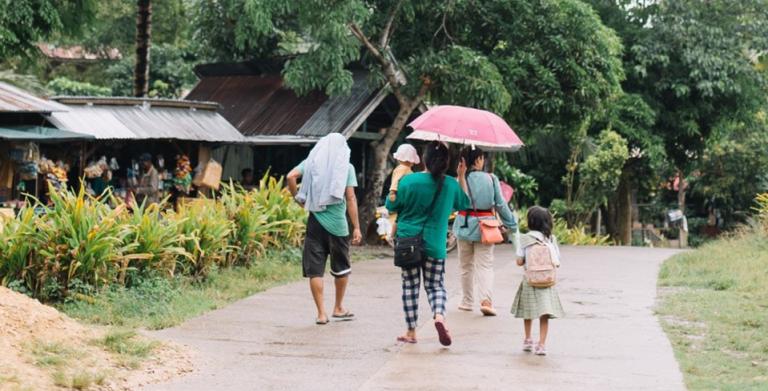
A mother picks up her kid from school, a baby in one arm and an umbrella in the other. No one will be left to care for the baby at home, so the mother brings her as she fetches her daughter.
The families in Mabinay have a traditional setup, with the father working and providing for the family, while the mother takes care of the children and the household. Women often become overworked in unpaid child-rearing and household management; they even work to help their husbands or partners in providing for the family. They farm in the sugarcane or rice fields, sell homemade delicacies near the school, or sell pretty much anything they can make at home. Meanwhile, the only expectation from a man is to work, not to prepare the kids for school, not to cook, and not even to keep the house clean.
If women ever got support from outside the family, it’s mostly from women too – the lola (grandmother), tiya (aunt), and ate (older sister/cousin). Even the house help or the usual “working student” (a full-time student and part-time house help who lives with the family that sponsors their education), in lower-middle to high-income families, not just babysits but also does household chores, is mostly a woman, and for a working student, a teenage girl.
Women are living with the double burden of having to be a woman in a traditional family and a woman in poverty. And in many barangays (villages) in Mabinay, schools, healthcare, and other social services are far from their homes. Support is much more out of reach for most Mabinayanon women.
Hands off, Gabriela!
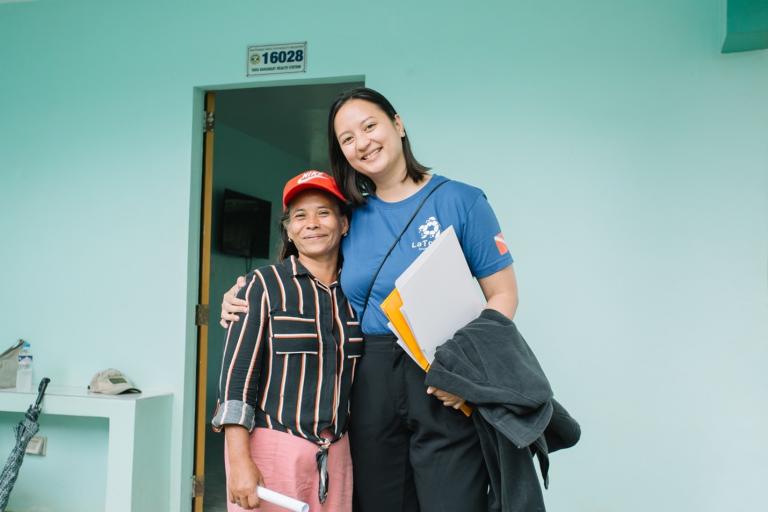
Gabriela Silang (1731–1763), a revolutionary military leader during the Spanish colonization, symbolized the resistance and the strength of Filipinas against injustice. A grassroots movement was named after her during the Marcos dictatorship in 1984, as Filipinas fought for their liberation from patriarchy and inequality. The alliance later became a political party advocating for laws that support women’s rights. I see a Gabriela in each and every woman I interviewed. These women fight every day for their children, for their families, and for themselves, amidst the very palpable abuse they experience from their partners. I saw the real impact of patriarchal values (and religious values in parallel)– putting so much physical, emotional burden on women, disempowering them to make decisions on their own and to keep the family whole, no matter what. I saw how poverty, making them dependent on their partners, entraps them, no matter how much they want to leave. I saw how the community with the same patriarchal values further discourages them from escaping their situations, and how the weak system of social and protective services fails to support them. To the patriarchy, and especially to the men who perpetuate violence – Hands off, Gabriella!
Meeting people where they are
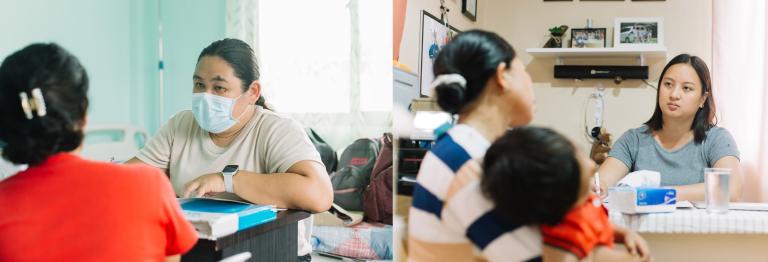
I could not have conducted my research without the help of hardworking and dedicated women – our research assistants, Ma’am Ellen Hamelon and Ma’am Karla Requieron, and most importantly, the participation of the strong and brave Mabinayanons we had the opportunity to interview and survey.
The women are mostly from hard-to-reach areas, some even from Geographically Isolated and Disadvantaged Areas (GIDA), where they had to travel long to reach any government services in the town proper. In my research, I made sure that we meet these women where they are. We scheduled the interviews and surveys, with the great coordination and support of the barangay midwives and Violence Against Women and Children (VAWC) officers, in these faraway barangays, so women don’t have to go to the health office in the municipal center. We also made sure to compensate the women for any possible transportation costs going to the barangay health centers that are more accessible and nearer to them. And we gave them incentives for the precious time they gave us to share their stories and experiences in their intimate relationships.
The interviews were very heavy, with almost all of the women breaking down, even when answering surveys, as they talked about what they had to go through in their relationship and in their families. But at the end of the interview or survey, the women felt very grateful that they were able to share. They felt relieved in unloading their burden. They felt heard, they felt seen.
Liberation
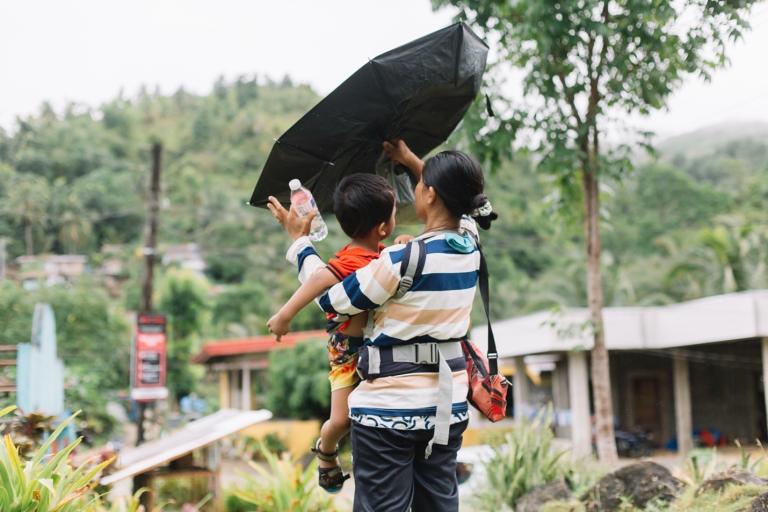
Who are we to judge women who stay in abusive relationships? No one truly knows what they are going through—what keeps them there, what systems (or the failure or lack of), what they had to risk, to endure to survive. Like this woman with her son with special needs, who knows what she had to go through as a mother to care for her children and her family? With all the adversities she faces, just like an uncooperative umbrella under the rain, she carries her son (and a bag and a water bottle) and the responsibilities of a woman, a mother, a wife. No one knows the weight she carries every day. And how all these things factor in on how she becomes free or trapped in her intimate relationship. These are what we want to understand in our research. And we want nothing but women like her to be liberated from violence.
*Aside from the first picture (people on the back of the truck), which I took, all photos were taken by Bea Banzuela of Bea Banzuela Photography.